
Automated labeling lines operate at remarkable speeds, where containers receive labels hourly. A sudden halt often occurs not from mechanical failure, but due to a microscopic material defect. A backing paper nicked during production can snap under tension, or an improperly weeded matrix pulls the label off its liner prematurely. Selecting a top 10 die-cutting service from China helps manufacturing operations maintain continuous production. Precision in conversion involves a balance of material science, depth control, and geometric accuracy rather than just cutting shapes.
For buyers navigating Asian manufacturers, finding a reliable die-cutting service demands an understanding of parameters separating standard converters from precision engineers. Label conversion requires managing materials that change under environmental conditions and mechanical stress. Without deep knowledge of substrate behavior, bulk orders suffer from inconsistent release forces, adhesive bleeding, or fractures along the die line. The packaging industry now requires technical expertise at every stage, turning a simple cutting process into a specialized discipline.
To address these challenges, SWLABEL (Zhejiang Shawei Digital Technology Co.,Ltd) integrates raw material manufacturing with converting processes to ensure that finished rolls or sheets function correctly on high-speed machinery. Managing the production cycle from chemical formulation to mechanical conversion provides consistent quality that supports automated packaging operations across industrial sectors.
Technical Pillars of the SWLABEL Production Standard
The foundation of high-performance conversion relies on specific operational criteria that directly influence how finished products perform on automated lines. The fabrication framework divides these technical challenges into five distinct production focus areas:
1. Comprehensive Substrate Adaptability
Label materials require different handling based on their specific physical properties. Standard papers require precise pressure adjustments to prevent fiber tearing, while synthetic films like polypropylene, polyethylene, and polyester demand sharp tooling and specific tension control to prevent stretching along the cut edge. Zhejiang Shawei Digital Technology Co.,Ltd utilizes its own coating production lines to analyze the tensile strength, elasticity, and shear resistance of each material batch. This technical integration allows operators to calibrate die-cutting machinery to the exact thickness and density of substrates like coated paper, thermal transfer stock, void anti-counterfeiting films, and metallic foils.
2. High-Flexibility Custom Geometric Tooling
Modern product packaging requires complex geometric shapes, demanding high flexibility in custom die design. Production lines process sharp angles, intricate internal cutouts, and continuous curves while maintaining structural integrity across the web. The converting facility works directly with engineering files in digital formats such as Adobe Illustrator and PDF to create precise rotary and flatbed tooling. To support product development cycles, the manufacturing setup accommodates small-batch prototyping alongside high-volume production, delivering finished labels in either roll or sheet formats based on the specific requirements of the client’s application machinery.
3. Precise Kiss-Cut Depth Calibration
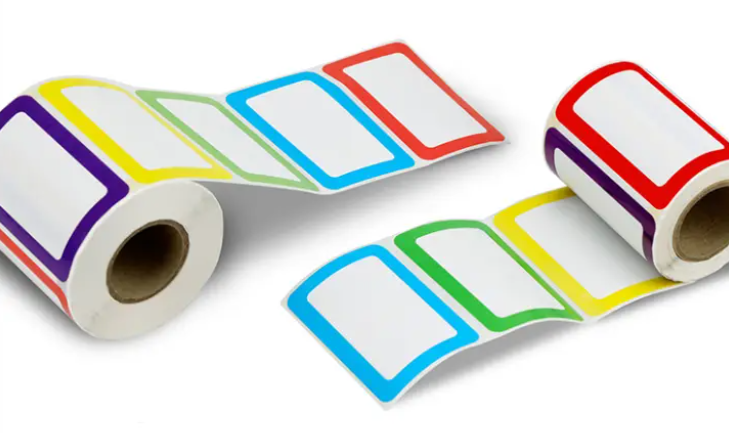
The core of successful label fabrication relies on precise kiss-cut depth control. The cutting blade must slice through the face stock and adhesive layer completely without marking or weakening the underlying release liner, which often measures only a few micrometers thick. Decades of mechanical calibration experience allow operators to manage clean cutting edges across extended production runs. This precision ensures that the surrounding waste material pulls away smoothly during the matrix stripping phase. Clean matrix removal prevents adhesive bridges from forming across the cut lines, allowing automatic labeling heads to peel and apply labels without tearing the backing material or jamming application systems.
4. Integrated Variable Data Processing
Industrial supply chains increasingly require integrated fabrication workflows to reduce processing times and lower logistics costs. The manufacturing setup combines variable data printing and mechanical converting into a single, continuous production pass. These custom printed die-cut labels incorporate barcodes, sequential serial numbers, and QR codes directly into the shaped design. Combining printing and cutting into one automated sequence eliminates secondary handling stages, reduces registration errors between the print and the cut line, and lowers the risk of surface contamination during processing.
5. Elastic Dimensional Configurations
Manufacturing capabilities must accommodate varying production volumes and dimensions to serve different industrial applications. The processing infrastructure handles material thicknesses ranging from 50 to 450 micrometers, supporting a wide array of application needs. The final products are delivered in diverse configurations, ranging from standard sheeted layouts used in manual applications to large jumbo rolls cut precisely for automatic labeling machinery. This flexible capability allows the production system to meet the tight tolerances required for compact electronic component markings as well as large-scale industrial container identification.
Structural Advantages of Integrated Material and Converting Facilities
Relying on external toll-converters or third-party cutting workshops often introduces manufacturing risks due to fragmented supply chains. When a converter sources face stock from one vendor, silicone liners from another, and adhesives from a third party, resolving web defects becomes technically difficult. A variation in adhesive coat weight or an uneven silicone layer can alter the required die-cutting depth, leading to blade penetration or incomplete cuts. SWLABEL mitigates these processing risks through an integrated production model that pairs chemical coating lines directly with advanced die-cutting machinery.
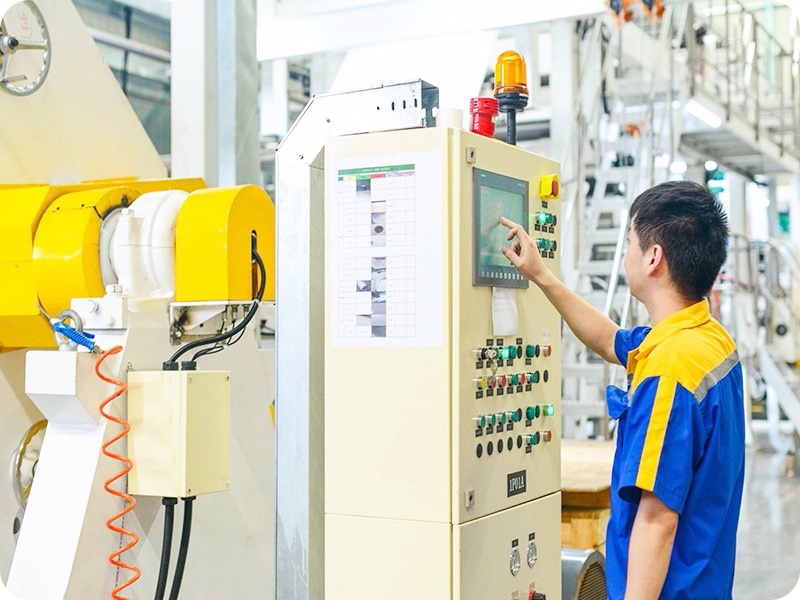
This closed-loop manufacturing system provides full visibility over the mechanical and chemical properties of each batch. Technical teams monitor the exact relationship between adhesive peel adhesion and liner release force before the material ever reaches the die station. This consistent control eliminates common conversion defects like adhesive bleeding along cut edges or material fracturing under matrix tension. Furthermore, the manufacturing facilities operate under an ISO 9001 quality management system. This framework enforces uniform dimensional tolerances and strict visual inspection protocols, ensuring that multi-million-unit production batches deliver predictable performance during high-speed application across global supply chains.
Reliable Standards in Precision Conversion
True professional quality in the conversion industry depends on a deep understanding of raw materials, refined mechanical processes, and responsive custom manufacturing. For businesses seeking a top 10 die-cutting service from China, consistent production outcomes rely on technical precision rather than basic cutting capabilities. By balancing material science with precise depth control, modern manufacturing ensures that simple labels function reliably on automated assembly lines.
Organizations looking to optimize their packaging workflows and explore custom material configurations can review detailed technical specifications and request product samples through the central corporate portal at https://www.zjswlabel.com/.
Post time: Jul-08-2026


